
Prepared by: Genki Houses Editorial Team | Information reviewed: 15 September 2026
Backup article 216 · Original WordPress 4850 · English family / PM2.5 / children / exposure reduction / nasal comfort
Bangkok’s seasonal haze can make parents feel they need one product that “blocks PM2.5.” The more reliable plan is layered: check air quality, reduce exposure when pollution is high, improve indoor filtration, manage asthma or rhinitis properly, and treat nasal care as supportive comfort—not as a substitute for exposure control.
The original page had a useful family-protection intent, but it overstated PVP Nose Spray as a protective barrier against PM2.5 and treated masks as universally suitable for children. This revision keeps the practical English-language value while tightening the evidence.
1. What PM2.5 is—and why children deserve extra attention
PM2.5 means airborne particles with aerodynamic diameter around 2.5 micrometres or smaller. These particles can reach deep into the respiratory tract. Children can be more vulnerable because their lungs are still developing, they are often active outdoors, and those with asthma or other respiratory disease may have more symptoms during polluted periods.
A single “safe” threshold for an individual child cannot be inferred from one day’s number. The practical use of an air-quality index is to change behaviour as pollution rises, especially for children with asthma, chronic lung disease or significant symptoms.
2. Start with exposure reduction, not a nose product
When PM2.5 is high, the hierarchy is straightforward:
- check a reliable local air-quality source before outdoor plans;
- shorten or reschedule strenuous outdoor activity when pollution is elevated;
- choose cleaner indoor spaces when possible;
- keep doors/windows closed when outdoor air is substantially worse than indoor air;
- use appropriately sized air cleaning/filtration where practical;
- follow the child’s asthma/rhinitis action plan if one exists.
No nasal spray can compensate for hours of avoidable high-PM exposure.
3. Indoor air: filtration matters more than perfume, plants or “detox” claims
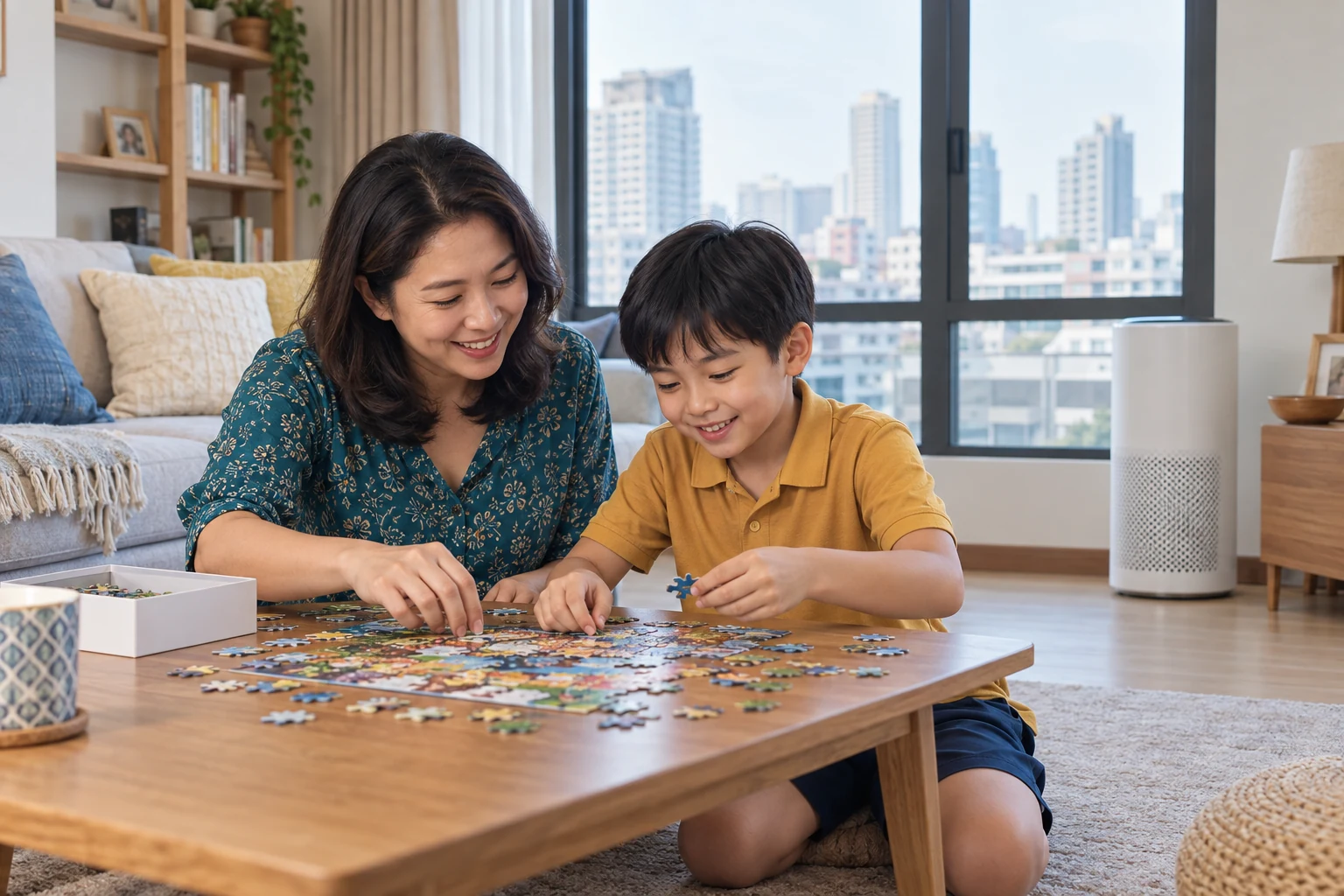
A portable air cleaner with a suitable particulate filter can reduce indoor particle concentration when correctly sized and operated. Central HVAC systems can also reduce particles when equipped with an appropriate high-efficiency filter and set up correctly.
Avoid creating new indoor pollution at the same time: smoking, burning incense/candles, heavy frying without ventilation and poorly vented combustion can all add particles.
Houseplants may be pleasant, but they should not be presented as a replacement for source control and mechanical filtration.
4. Masks and children: fit is the hard part
A respirator only works well when the filter is capable and the seal fits the face. Adult occupational N95 guidance cannot simply be copied onto a toddler.
For older children who can tolerate and correctly wear a well-fitting high-filtration mask, fit and continuous use matter. For very young children, poorly fitting masks may provide little benefit and can create practical problems. Parents should prioritise reducing exposure and keeping indoor air cleaner rather than assuming any mask labelled “N95” automatically protects a child.
Children with breathing problems or difficulty tolerating a respirator may need individual advice.
5. What nasal saline or a PVP-containing spray can reasonably do
Nasal saline or other non-drug nasal-care products may help with dryness, crusting, irritation and removal of mucus/particles from the nasal cavity for some users. That is an adjunctive-care role.
For PVP Nose Spray, the current project evidence does not establish a clinical claim that the finished product blocks PM2.5, prevents allergens from entering the body, prevents asthma attacks or prevents respiratory infection. A film-forming ingredient concept is not the same as a demonstrated real-world protection outcome.
So the correct positioning is:
- supportive nasal cleansing/moisturising/comfort;
- not a respirator;
- not an air purifier;
- not an asthma or allergic-rhinitis medicine;
- not proof of reduced PM2.5 dose to the lungs.
6. If a child has allergic rhinitis or asthma, treat the disease—not only the dryness
PM2.5 can worsen respiratory symptoms, but a blocked or runny nose may also come from allergic rhinitis, viral infection, irritants, sinus disease or other causes.
If a child already has prescribed asthma or rhinitis treatment, continue it as directed. A supportive nasal spray should not replace inhaled asthma therapy, intranasal corticosteroids when indicated, antihistamines when appropriate, or medical assessment of worsening symptoms.
Repeated nighttime cough, wheeze, exercise limitation or frequent rescue-inhaler use deserves clinical review rather than repeated “detox” or nasal-cleansing experiments.
7. Build a family PM2.5 plan before the bad-air day
A simple plan can include:
- where the family checks air quality;
- which room becomes the cleaner-air room;
- when outdoor sport will be shortened or moved indoors;
- where medicines and spacers are kept for a child with asthma;
- how school/caregivers should respond if symptoms appear;
- which symptoms mean the child needs medical care.
Planning ahead is more effective than buying multiple “anti-dust” products after symptoms start.
8. When to seek medical care
Seek urgent assessment for severe breathing difficulty, blue/grey lips, marked chest retractions, inability to speak/cry normally because of breathlessness, unusual drowsiness, or a severe asthma attack not responding to the child’s rescue plan.
Arrange medical review for persistent cough/wheeze, recurrent nighttime symptoms, reduced exercise tolerance, fever or symptoms suggesting infection, or nasal symptoms that remain troublesome despite reasonable environmental control and appropriate treatment.
9. The practical bottom line
Protecting a family from PM2.5 is primarily an exposure-control problem. Air-quality awareness, cleaner indoor air and appropriate respiratory-disease management do the heavy lifting.
Nasal care can be useful for comfort, but Genki Houses should not turn “film-forming” into “clinically proven PM2.5 barrier” without direct finished-product evidence. The best English family guide is therefore layered and realistic: reduce what is inhaled first; then use supportive care for the symptoms that remain.
References and evidence boundaries
- World Health Organization. Air pollution: Personal interventions and risk communication. https://www.who.int/news-room/questions-and-answers/item/air-pollution-personal-interventions-and-risk-communication
- World Health Organization. WHO global air quality guidelines. https://www.who.int/publications/i/item/9789240034228
- US Environmental Protection Agency. Protect Children from Wildfires, Smoke, and Volcanic Ash. https://www.epa.gov/children/protect-children-wildfires-smoke-and-volcanic-ash — used for child vulnerability and exposure-reduction principles, not to equate Bangkok haze with wildfire smoke.
- US EPA. Strategies to Reduce Exposure Indoors. https://www.epa.gov/wildfire-smoke-course/strategies-reduce-exposure-indoors
- Genki Houses project source: original WP4850 and product evidence records for PVP Nose Spray.
Boundary: this manuscript does not approve a finished-product PM2.5-blocking, allergen-blocking, asthma-prevention or infection-prevention claim for PVP Nose Spray.